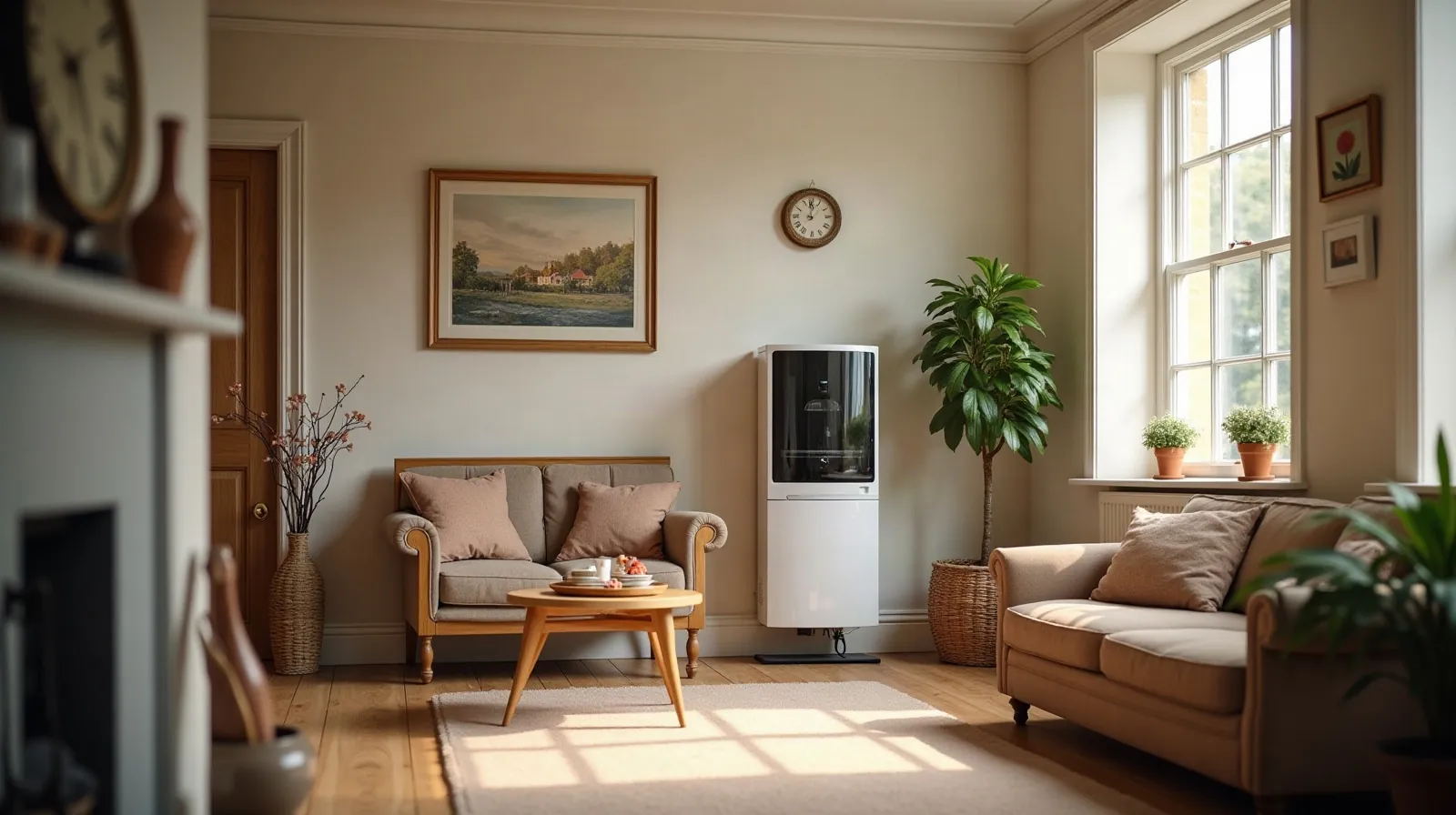
The Boiler Upgrade Scheme provides £7,500 towards an air source or ground source heat pump in England and Wales. Extra help is available for oil and LPG homes until March 2027. Planning permission may be needed depending on your property and location. Building regulations approval or a competent person installer is required.
The Boiler Upgrade Scheme
The Boiler Upgrade Scheme is open in England and Wales. It offers £7,500 towards an air source or ground source heat pump. For a biomass boiler, the grant is £5,000, and for an air-to-air heat pump, it is £2,500. The scheme is administered by Ofgem on behalf of the government. You apply through an MCS certified installer who will check eligibility and submit the application.
Capacity limits apply to the scheme. Individual systems must not exceed 45kWth. Shared ground loops must not exceed 300kWth. These limits determine the maximum grant available. Your installer will confirm the capacity of your proposed system and ensure it meets the scheme requirements. The grant is paid directly to the installer and deducted from your quote.
Hybrid systems that combine a gas boiler and a heat pump are not eligible for the Boiler Upgrade Scheme. Only standalone heat pump systems qualify. If you are considering a hybrid system, you will not receive grant funding. Check with your installer whether your proposed system meets the scheme rules before proceeding.
Extra help for oil and LPG homes
Until March 2027, an extra £1,500 is available for air source or ground source heat pumps where the home is heated by oil or LPG and has no mains gas. This is in addition to the standard £7,500 grant. The extra funding is designed to help off gas grid homes switch to a heat pump. You must meet the scheme criteria to qualify.
To receive the extra £1,500, your home must currently be heated by oil or LPG and must not have a mains gas connection. The extra grant is available for both air source and ground source heat pumps. It is not available for biomass boilers or air-to-air heat pumps. Your installer will confirm whether your property qualifies for the additional funding.
The extra funding is time limited and ends in March 2027. If you are considering a heat pump installation, you should check the current scheme rules with your installer. The grant amounts and eligibility criteria may change. Always confirm the details before committing to an installation.
What is not covered
Hybrid systems combining a gas boiler and heat pump are not eligible for the Boiler Upgrade Scheme. This means you cannot receive a grant for a system that includes both a gas boiler and a heat pump. If you are considering a hybrid system, you will need to fund the installation yourself. Check with your installer whether your proposed system qualifies.
The scheme does not cover air-to-air heat pumps at the £7,500 rate. Air-to-air heat pumps receive £2,500. Biomass boilers receive £5,000. The grant amounts are fixed and depend on the type of system installed. There is no funding for other heating systems such as solar thermal or electric storage heaters.
The scheme does not cover the cost of necessary upgrades such as insulation, radiators, or pipework. These costs are separate and must be met by you. Your installer can provide a quote for the full installation, including any additional work required. The grant is only towards the cost of the heat pump itself.
Planning rules for air source heat pumps
Permitted development rights allow certain air source heat pumps to be installed without a planning application. To use permitted development, the installation must comply with the MCS Planning Standards. These standards cover noise and other installation requirements. Your installer should confirm that the proposed installation meets the MCS Planning Standards.
The outdoor unit cannot exceed 1.5 cubic metres on a house or 0.6 cubic metres on a block of flats. There are also limits on the number of heat pumps. Not more than one heat pump is allowed on a non detached house, or two on a detached house. These limits apply to permitted development.
The outdoor unit must not be installed on a pitched roof, or within 1 metre of the edge of a flat roof. These rules are designed to reduce visual impact and ensure safety. If your proposed location does not meet these rules, you may need to apply for planning permission.
In conservation areas, the outdoor unit must not be installed on a wall or roof fronting a highway. This rule applies even if the installation would otherwise be permitted development. Check with your local council if your property is in a conservation area.
Where a heat pump needs permission
A heat pump is not permitted development at a listed building or scheduled monument. You will need to apply for planning permission and possibly listed building consent. Check with your local council before carrying out any work. The rules for listed buildings are strict and you should seek professional advice.
In conservation areas, permitted development rights are restricted. A heat pump cannot be installed on a wall or roof fronting a highway. This means you may need planning permission if your property is in a conservation area and the installation would be visible from a highway. Check with your council.
Councils can remove permitted development rights with an Article 4 direction. This means you may need planning permission even if the installation would normally be allowed. Always check with your local council first to see if an Article 4 direction affects your property. You can also apply for a lawful development certificate to confirm that proposed work is lawful.
Building regulations and installers
Installing or replacing a heating system can need building regulations approval, or a competent person installer. Building regulations cover the safety and energy efficiency of the installation. You should ensure that the work is carried out to the required standards. Your installer should be able to advise you on building regulations compliance.
A competent person installer is registered with a scheme that allows them to self certify that their work complies with building regulations. If you use a competent person installer, you do not need to apply separately for building regulations approval. Always check that your installer is registered with a recognised competent person scheme.
If your installer is not a competent person, you will need to apply to your local council for building regulations approval. This involves submitting plans and having the work inspected. The council will issue a certificate when the work is complete. You should factor this into your project timeline and budget.
General information, not professional advice. Rules vary by council and change over time; check with your local authority or a qualified professional before starting work or buying.
Frequently asked questions
How much can I get towards an air source heat pump?
The Boiler Upgrade Scheme offers £7,500 towards an air source heat pump in England and Wales. An extra £1,500 is available until March 2027 for oil or LPG homes with no mains gas.
Do I need planning permission for an air source heat pump?
Many installations are permitted development if they meet the MCS Planning Standards and size limits. However, listed buildings, conservation areas, and Article 4 directions may require planning permission. Check with your local council.
What are the size limits for permitted development?
The outdoor unit cannot exceed 1.5 cubic metres on a house or 0.6 cubic metres on a block of flats. There are also limits on the number of units and their location.
Can I get a grant for a hybrid system?
No, hybrid systems combining a gas boiler and heat pump are not eligible for the Boiler Upgrade Scheme. Only standalone heat pump systems qualify.
Do I need building regulations approval?
Installing or replacing a heating system can need building regulations approval, or a competent person installer. Check with your installer or local council to ensure compliance.
Sources
- GOV.UK: Apply for the Boiler Upgrade Scheme
- The Town and Country Planning (General Permitted Development) (England) Order 2015, Schedule 2 Part 14
- GOV.UK: Building regulations approval
- MHCLG permitted development rights for householders, technical guidance
- GOV.UK: Lawful development certificates
Checked 20 November 2026.