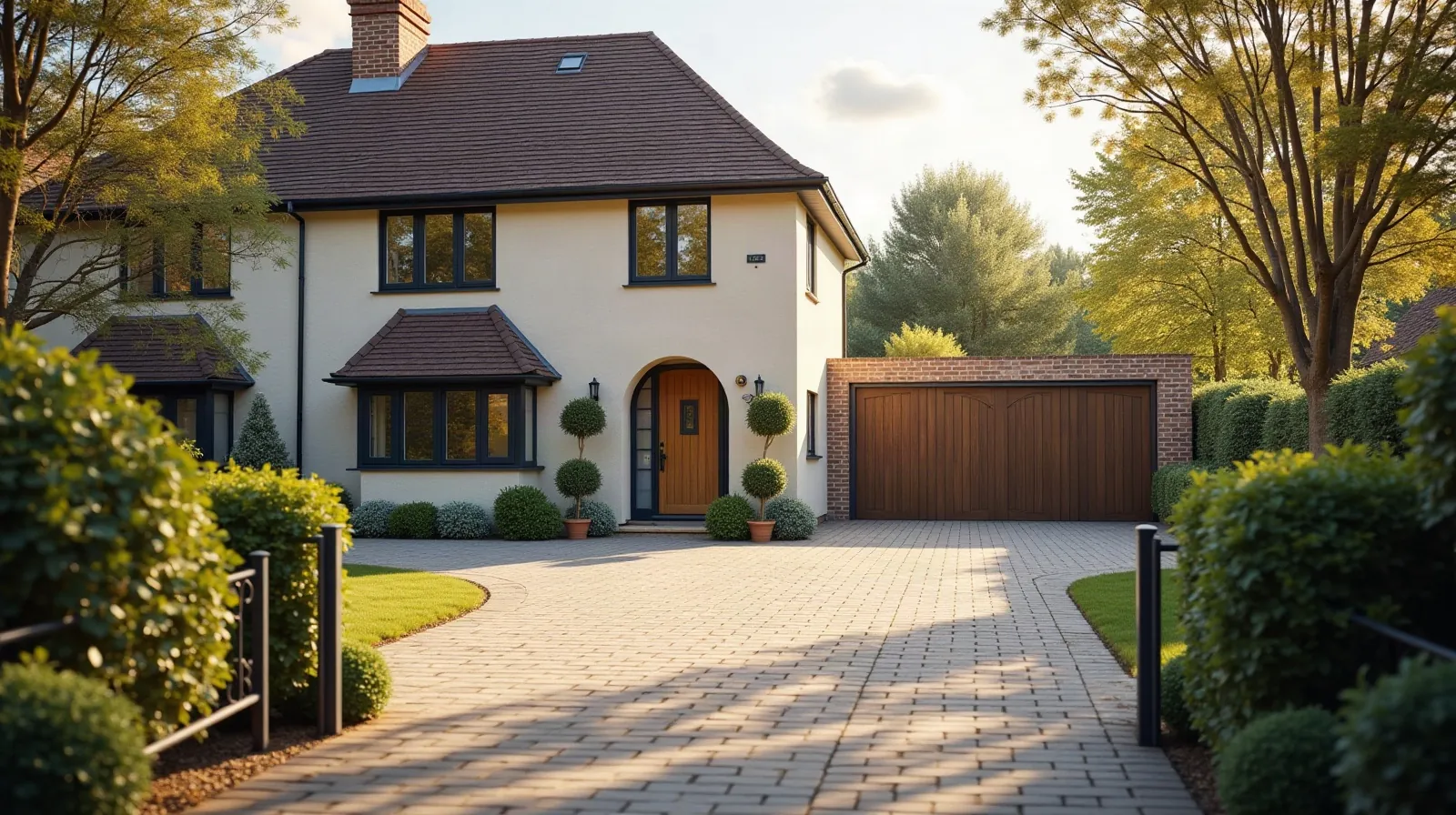
Under Class F permitted development in England, a hard surface between the principal elevation of your house and a highway that is over 5 square metres must be porous or drain to a permeable area within your property. Surfaces of 5 square metres or less do not need to meet this condition. Check with your local council first.
The rule for front gardens
Class F permitted development covers hard surfaces within the curtilage of a house in England. The curtilage is the land around your home that is used with it, such as a front garden or drive. If you want to lay a hard surface between the principal elevation of your house and a highway, and that surface is over 5 square metres, the rule applies. The principal elevation is the front of the house as originally built, usually facing the road. The surface must then be porous or drain to a permeable area within your property.
The 5 square metre figure is a threshold, not a target. A surface of exactly 5 square metres or less does not need to meet the porous or drainage condition under Class F. A surface over 5 square metres does. Measure the area of the new hard surface, not the whole garden. If you are replacing an existing surface, the same rule applies to the new surface. Keep the measurement clear in case you need to show it later.
This rule covers England. It does not apply in Scotland, Wales or Northern Ireland, where different rules apply. In England, the rule applies to houses, but some homes are excluded. Homes created by change of use permitted development under Classes M, N, P, PA or Q are not covered by Class F. If your home was converted under one of those classes, you cannot rely on Class F for a new hard surface. You would need to check with your local council what rules apply.
The rule is about where the water goes. A porous surface lets water drain through it. A non porous surface must drain to a permeable area within your property, such as a lawn or border. Water must not run off your property onto the highway or a neighbour's land. If you are unsure whether your planned surface meets the condition, ask your local council or a qualified professional before you start work.
Permeable and porous surfaces
A porous surface has gaps or pores that let water pass through. Examples include gravel, permeable block paving and porous asphalt. These surfaces allow rainwater to soak into the ground below. A permeable area is a part of your property that water can drain into, such as soil, grass or a planted border. If you use a non porous surface such as standard concrete or tarmac, you must make sure water drains to a permeable area within your property.
The condition is that the surface is porous or drains to a permeable area within your property. It is not enough for water to drain to the road or to a neighbour's land. You may need to slope the surface towards a lawn or a soakaway within your boundary. A soakaway is a hole filled with gravel that lets water soak into the ground. If the ground is clay or already wet, a soakaway may not work well. Ask a qualified professional for advice on drainage.
You do not need permission for a porous surface under Class F if the other conditions are met. But you must still check that permitted development rights have not been removed. Councils can remove permitted development rights with an Article 4 direction. Earlier planning permissions may also have removed them. Check with your local council before you rely on Class F. If rights have been removed, you may need a planning application.
The 5 square metre rule applies to the area of the hard surface. If you lay a porous surface, the rule is met. If you lay a non porous surface over 5 square metres, you must show that it drains to a permeable area within your property. Keep evidence of the surface type and drainage in case the council asks. A lawful development certificate from the council confirms that proposed work is lawful.
Back gardens and side areas
The 5 square metre rule applies only between the principal elevation and a highway. A back garden is not between the principal elevation and a highway, so the rule does not apply there. A side area may or may not be between the principal elevation and a highway. If the side area is not between the front of the house and a road, the rule does not apply. If it is, the rule applies in the same way as for a front garden.
Class F permitted development covers hard surfaces within the curtilage of a house. For back gardens and side areas that are not between the principal elevation and a highway, Class F may allow a hard surface without the porous or drainage condition. But other rules may still apply. For example, if the surface is next to a road used by vehicles, gates and walls may be limited to 1 metre without permission. Check the position of your surface carefully.
Even where the 5 square metre rule does not apply, permitted development rights may have been removed. Councils can remove rights with an Article 4 direction. Earlier permissions may also have removed them. Check with your local council first. If you are in a conservation area or other Article 2(3) land, tighter rules apply. Article 2(3) land includes National Parks, the Broads, Areas of Outstanding Natural Beauty, conservation areas and World Heritage Sites.
If you are unsure whether your back garden or side area is between the principal elevation and a highway, ask your local council. The principal elevation is a matter of fact, usually the front of the house as originally built. A side area that faces a road may be treated as between the principal elevation and a highway if it lies in front of the principal elevation. The council can confirm this for your property.
Gates and walls by the drive
Gates and walls next to a road used by vehicles are limited to 1 metre without permission. This is a separate rule from the 5 square metre rule. It applies to gates and walls, not to the hard surface itself. If you want a gate or wall higher than 1 metre next to a road used by vehicles, you may need planning permission. The limit is 1 metre without permission. Check with your local council before you build.
The 1 metre limit applies next to a road used by vehicles. A road used by vehicles includes a public highway and may include a private road. If your drive meets a road used by vehicles, a gate or wall at the boundary may be subject to the 1 metre limit. The limit is about height. Measure from the ground on the road side. If the ground slopes, the measurement may be taken at the highest point. Ask your local council for guidance.
This rule is separate from Class F. You may meet the 5 square metre rule for your hard surface but still need permission for a gate or wall over 1 metre. Conversely, a gate or wall of 1 metre or less may not need permission even if the surface rule applies. Check both rules before you start work. If permitted development rights have been removed by an Article 4 direction, the 1 metre limit may not apply and you may need permission for any gate or wall.
In Article 2(3) land, tighter rules apply. This includes National Parks, the Broads, Areas of Outstanding Natural Beauty, conservation areas and World Heritage Sites. The 1 metre limit may be different, or permitted development rights may be removed. Check with your local council first. A lawful development certificate from the council confirms that proposed work is lawful. You can apply for a certificate before you build.
Converted homes
Class F does not apply to homes created by change of use permitted development under Classes M, N, P, PA or Q. These classes allow changes of use without a full planning application. If your home was created under one of these classes, you cannot rely on Class F for a new hard surface. You would need to check with your local council what rules apply. You may need a planning application for the surface.
Classes M, N, P, PA and Q cover different types of change of use. Class M covers shops and similar uses to homes. Class N covers amusement arcades and casinos to homes. Class P covers storage and distribution to homes. Class PA covers light industrial to homes. Class Q covers agricultural buildings to homes. If your home was created under one of these classes, Class F does not apply. This is the case even if the home is now a house.
If you live in a converted home, check the planning history before you lay a hard surface. The council can tell you which class was used. If Class F does not apply, you may need to apply for planning permission. A lawful development certificate from the council confirms that proposed work is lawful. You can apply for a certificate to confirm whether your planned surface is lawful. The council will decide based on the facts.
Even if Class F does not apply, other permitted development rights may apply. But you should not assume this. Check with your local council first. If permitted development rights have been removed by an Article 4 direction, you may need permission for any hard surface. In Article 2(3) land, tighter rules apply. A qualified professional can help you check the planning history and prepare an application if needed.
Checking before you pave
Before you lay a hard surface, check with your local council. Councils can remove permitted development rights with an Article 4 direction. Earlier permissions may also have removed them. Check the planning history for your property. Ask the council whether Class F applies to your home. If your home was created under Classes M, N, P, PA or Q, Class F does not apply. If you are in Article 2(3) land, tighter rules apply.
Article 2(3) land includes National Parks, the Broads, Areas of Outstanding Natural Beauty, conservation areas and World Heritage Sites. In these areas, permitted development rights are more limited. Check with the council before you rely on Class F. The 5 square metre rule may still apply, but other restrictions may also apply. For example, the 1 metre limit for gates and walls next to a road used by vehicles may be different.
A lawful development certificate from the council confirms that proposed work is lawful. You can apply for a certificate before you start work. The certificate is a formal decision by the council. It can give you confidence that your planned surface is lawful. The council will consider the facts and the planning history. You may need to provide plans and a description of the surface and drainage.
If you are unsure about the rules, ask your local council or a qualified professional. The rules depend on your property and its planning history. Do not assume that permitted development rights apply. Check first. Keep records of your measurements and surface type. If you need permission, apply before you start work. Building without permission can lead to enforcement action by the council.
General information, not professional advice. Rules vary by council and change over time; check with your local authority or a qualified professional before starting work or buying.
Frequently asked questions
What is the 5 square metre rule for driveways?
Under Class F permitted development in England, a hard surface over 5 square metres between the principal elevation and a highway must be porous or drain to a permeable area within your property. Surfaces of 5 square metres or less do not need to meet this condition.
Does the rule apply to back gardens?
The 5 square metre rule applies only between the principal elevation and a highway. A back garden is not between the principal elevation and a highway, so the rule does not apply there. Other rules, such as the 1 metre limit for gates and walls, may still apply.
Can my council remove permitted development rights?
Yes. Councils can remove permitted development rights with an Article 4 direction. Earlier permissions may also have removed them. Check with your local council before you rely on Class F. If rights have been removed, you may need a planning application.
Do converted homes have different rules?
Yes. Class F does not apply to homes created by change of use permitted development under Classes M, N, P, PA or Q. If your home was created under one of these classes, you cannot rely on Class F. Check with your local council what rules apply.
What is a lawful development certificate?
A lawful development certificate from the council confirms that proposed work is lawful. You can apply for a certificate before you start work. The council will decide based on the facts and the planning history. It can give you confidence that your planned surface is lawful.
Sources
- MHCLG permitted development rights for householders, technical guidance
- The Town and Country Planning (General Permitted Development) (England) Order 2015, Schedule 2 Part 2
- GOV.UK: Lawful development certificates
Checked 20 November 2026.